Light up your Christmas. The most illuminated night in Colombia.

Light up your Christmas. The most illuminated night in Colombia.

The night of the candles, a Colombian tradition

Por: Camila Garcia Voelkl.

In many cultures, Christmas season is characterized by its lights. We light up the tree, we decorate the houses with colored lights and the cities illuminate their streets and main squares. In Colombia, there is a beautiful tradition where the Christmas lights take center stage and it is known as the night of the candles.

How was this tradition born?

Colombia is a country with very strong Catholic roots. The Catholic Church celebrates the Immaculate Conception of the Virgin on December 8, where it is remembered that the Virgin Mary was sinless (immaculate) from her conception. In 1854, colonial times, the tradition of celebrating the Virgin with candles to illuminate her path was consolidated in Colombia. “According to certain theologians, such as Álvaro Rodríguez Vásquez, the night of the candles means the illumination that God made in the Virgin and her acceptance of that divine process”1

Although this celebration is of religious origin, for Colombians it also has a big family and cultural connotation.

The brightest night.

The night of the candles begins on the night of December 7 and the early morning of December 8 when family and friends gather to light up their houses, streets and squares with lanterns, candles and colored gunpowder, in the midst of a festive atmosphere. In some cities like Medellín and Barranquilla, the lights are also placed on the riverbank.

Photo by: http://asomecosafro.com.co/
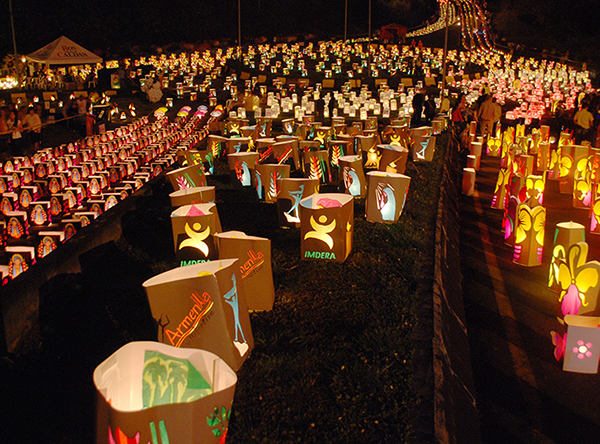
It is perhaps the brightest night of the year in Colombia and the beginning of a month of festivities. It is a tradition full of joy. Each candle is lit with an intention of gratitude for the good things of the current year and with the best wishes for the coming year. For others it is a way to remember loved ones who are no longer with them. For the vast majority, one more reason to share a moment of joy with the family.

Foto por: Cristian Mercado https://zonacero.com/
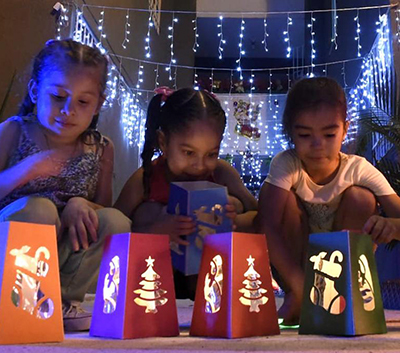
Join the tradition.

The night of the candles is a reason to share and spend time together. For the little ones, the lights fill the moment with magic and become unforgettable moments of the season. The tradition is not limited to the night. It starts with making handmade lanterns at home using colored paper and decorating them with Christmas motifs. The tradition is to use wax candles and gather around the candles, telling stories and sharing something to eat while watching the candles burn little by little. However, for safety reasons with small children, you can also use LED lights.

How to make a lantern at home:

Si encontraste util este post, ayudame a seguir compartiendo nuestras tradiciones!

Cooking Arepas with Choko

Cooking Arepas with Choko

Colombian and Venezuelan Arepas Recipe.

Por: Camila Garcia Voelkl.

“Arepas” are cornmeal round and flat cakes that originated hundreds of years ago in Colombia and Venezuela. It is a typical meal that is cooked on a rack, pan-fried or baked. They can be served as bread or use them for sandwiches with fillings such as cheese, beans, chicken, meat, veggies or many other options.

At home, my kids love arepas at breakfast, snack or even dinner. They love how versatile they are and how they can be combined with their favorite toppings. As a Colombian, I love to see them eat their arepas with such taste and pride.

My husband is Mexican, and he likes his arepa alongside some good beans, hot sauce, and avocado. My oldest daughter loves to top it with guacamole and my youngest loves it with hummus. I personally prefer it plain or stuffed with cheese!

It does not matter with which you accompany it or fill it, the arepa goes well with everything.

One of the things I like the most about this recipe is how easy it is to prepare, and it has allowed my daughters to join while cooking and share as a family, especially my youngest daughter, who is currently 6, loves to make the dough and form the arepitas using a tortillera (exactly, we do not have arepera, but we do have tortillera and they work the same).

Here is the recipe and if you make it at home, I would love to see you in action or the result. You can share your experience on Facebook or Instagram with the hashtag #arepasamigobilingue


Colombian and Venezuelan Arepas – Recipe

Prep:           10 mins
Cook:          10 mins
Total:          20 mins
Yield:          6 arepas

INGREDIENTS

2 cups of corn flour
2 cups of water
Pinch of salt
Avocado or olive oil (Spray)

*optional: 1 cup of mozzarella grated cheese. If added, the recipe is not dairy free anymore unless you use a plant based type of cheese.

Mix water, corn meal, mozzarella cheese (optional), PINCH oF salt together in a large bowl. Knead until mixed well and the dough has a soft consistency.

Form balls the size of a medium orange and shape them as a semi flat circle or place them between 2 sheets of plastic wrap and Flatten with a rolling pin to your desired thickness.

Coat a griddle or frying panwith cooking oil spray and heat to medium-high. Add arepas and grill until golden brown, about 5 minutes per side. Serve immediately.

 Arepas have a mild flavor so they go well with almost everything. You can try using two flat Arepas or one opened in half and filled it with your choice of shredded chicken, meat, vegetables, chesses, beans, hummus and much more.

Similar to arepas are the mexican “gorditas” and the salvadorian “pupusas”. They are also round flat corn cakes Gorditas are puffed up when fried in oil, forming an air pocket which is later filled. Pupusas are flatter and made with a corn flour stronger in flavor than the one used for arepas.


AT HOME

You can download, print and share the recipe with family and friends. Here is a PDF for you to keep. Available in English and Spanish!

greeting_dialog_display=”hide”